
PA One Book Activities for The Great Cookie Kerfuffle
The Pennsylvania One Book initiative is a valuable program that highlights the importance of early literacy development in preschoolers and the significance of reading early and often to children, as well as engaging them in conversation and other activities around books. The program has remained successful in part due to the partnership of collaborating agencies that all support early childhood literacy efforts.
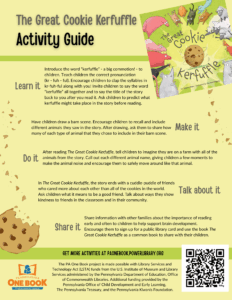
Printable Activity Guides
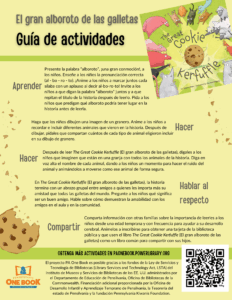
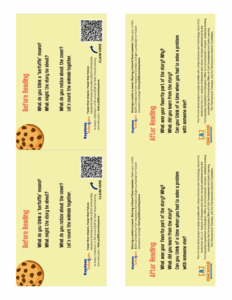
Additional Printable Resources
Approaches to Learning through Play
Activity Title: Who Stole the Cookies from the Cookie Jar?
Corresponding PA Early Learning Standard:
- AL.1 PK.C Engage in complex play sequences with two or more children.
- AL.2 PK.D Recognize and extend simple patterns.
Materials: Bean bag or plastic cookie
Instructions:
- Have children sit in a circle and close their eyes.
- While all the children have their eyes closed, walk around the outside of the circle and select one child to be the “cookie thief.” Give them a bean bag or plastic cookie to be the cookie prop. Ask the child to hide the “cookie” out of sight– in a pocket, right behind them, sit on it, etc.
- Now everyone can open their eyes!
- Ask for someone to make a first guess for who stole the cookie. Then begin the rhyme. Encourage children to tap their knees or clap their hands as they chant along with the song:
- EVERYONE: Who stole the cookie from the cookie jar?
- EVERYONE: [Insert name- Sarah, for example] Sarah stole the cookie from the cookie jar.
- SARAH: Who, me?
- EVERYONE: Yes, you!
- SARAH (if she does not have the cookie): Couldn’t be!
- EVERYONE: Then who?
- SARAH can guess the name of another child.
- The pattern repeats until the cookie thief is guessed correctly. The student with the cookie can pull it out and pass it around the circle as if “sharing” with the rest of the class.
- Feel free to hide multiple “cookies” if you have a big group. Just be sure to tell the class in advance how many cookie thieves they have to find.
- When repeating the game, you could ask the child who had the cookie to select the next “cookie thief.”

Social and Emotional Development
Activity Title: Charades
Corresponding PA Early Learning Standard:
- 16.1 PK.A Distinguish between emotions and identify socially acceptable ways to express them
Materials: None
Instructions:
- Have all the children stand up in a circle.
- State an emotion the animals felt during the book.
- Ask the children to act out that emotion.
- Discuss what it means to feel that emotion.
- Repeat until children are no longer engaged.

Language and Literacy Development
Activity Title: How Should They Share?
Corresponding PA Early Learning Standard:
- 1.4 PK.W With guidance and support, recall information from experiences or books.
Materials: None
Instructions:
- Ask: What should the animals have done with the cookie
- Do: Children draw their solution and dictate or write a sentence explaining their thinking.
- Focus: Support ideas with simple reasoning.
Activity Title: Story Retell with Props
Corresponding PA Early Learning Standard:
- 1.3 PK.A With prompting and support, retell a familiar story in a sequence with picture support.
Materials:
- Simple puppets or pictures that look like the characters from The Great Cookie Kerfuffle.
Instructions:
- Provide character puppets (squirrels, mouse, cookie).
- Support children in retelling the story in sequence (beginning, middle, end).
- Encourage use of story vocabulary: argue, share, solve, fair.
Mathematical Thinking and Expression
Activity Title: Five Little Chocolate Chips
Corresponding PA Early Learning Standard:
- 2.1 PK.A.1 Know number names and the count sequence
- 2.1 PK.A.2 Count to tell the number of objects
Materials: None
Instructions:
- Choose five children to be the chocolate chips and stand up. If you have more than five, depending on the size of your group, you could adapt the rhyme to the total number of children.
- Sing the rhyme:
- Five little chocolate chips
- In a bowl of dough
- They knew into a cookie
- They soon would go
- Then on came the oven (all the rest of the children wave hands toward the “chocolate chips” to pretend to be heatwaves)
- And the dough turned brown
- And one of those chips melted right down (one child sits down)
- Repeat with the rest of the children, one at a time, counting down until zero chocolate chips are left.
- While they’re singing, have all the children show on their fingers each number as they count down from five (or whatever number you’re using) as each “chocolate chip” is melted.
Activity Title: What’s that Number?
Corresponding PA Early Learning Standard:
- 2.1 PK.A.1 Know number names and the count sequence
- 2.1 PK.A.2 Count to tell the number of objects
Materials:
- Magnetic or felt numbers
- Bag or box that you can’t see through
Instructions:
- Hide magnet or felt numbers (or puzzle pieces) 1 through 5 in a bag or box.
- Pull a number out one at a time and have the children call out what number it is.
Activity Title: Cookie Counting Fun
Standard Connection:
- 2.2 PK.A.1 Understand addition as putting together and adding to, and understand subtraction as taking apart and taking from.
Materials:
- Magnetic or felt numbers
- Bag or box that you can’t see through
Instructions:
- Hide magnet or felt numbers (or puzzle pieces) 1 through 5 in a bag or box.
- Pull a number out one at a time and have the children call out what number it is.
Activity Title: The Great Kerfuffle: Big or Small
Corresponding PA Early Learning Standard:
-
- 2.1 PK.A.3 Compare numbers.
Materials:
Choose one to use:
- stuffed animals
- cut out pictures
- drawings
- blocks
- figurines
Instructions:
- Give each child two mice, four hens, and six dogs.
- Have each child lay out the animals in front of them, matching the animals.
- Ask the children which group has the smallest number.
- Ask the children which group has the biggest number.
- Have the children create their own groups, mix and match the animals.
- Play as long as the children are engaged.

Scientific Thinking and Technology
Activity Title: Animal Habitats Exploration
Corresponding PA Early Learning Standard:
- 3.4 PK.A Identify natural resources available to people in their daily lives.
Materials:
- Pictures of various animal habitats
- Blocks
- Sticks
- Leaves
- Moss
- Twigs
- Old newspaper
Instructions:
- Discuss where squirrels, mice, and other animals live.
- Compare habitats (trees, burrows).
- Build simple habitat model in the block area using gathered materials on newspaper.
Activity Title: Cookie Comparison
Corresponding PA Early Learning Standard:
- 3.2 PK.A Different kinds of matter exist, and matter can be described and classified by its observable properties.
Materials:
- Printed images of a variety of cookies
Instructions:
- Print pictures of several different types of cookies, enough for children to each get at least one cookie.
- Pass out one cookie to each child and have them turn to a friend to compare cookies.
- Model the types of questions the children can ask as they observe the two cookies side-by-side:
- How are the two cookies the same?
- How are they different?
- Are they the same shape?
- Do you think they have similar ingredients?
- Have you ever tasted this type of cookie before?
Activity Title: Do Cookie Ingredients Sink or Float?
Corresponding PA Early Learning Standard:
- 3.2 PK.A Different kinds of matter exist, and matter can be described and classified by its observable properties.
Materials:
- All-purpose flour (in sealed bag)
- Sugar (in sealed bag)
- Chocolate chips
- Large clear bowl of water
- Chart paper
- Markers
Instructions:
- Explore flour, sugar, chocolate chips.
- Predict and test which items sink or float in water.
- Chart children’s predictions on chart paper.
- Discuss the results compared to children’s predictions.

Social Studies Thinking
Activity Title: Classroom Constitution – Sharing Rules
Corresponding PA Early Learning Standard:
- 5.3 PK.F Identify appropriate behaviors for responsible classroom citizens
- 5.2 PK.A Identify self-membership of a group such as the class or family
Materials:
- Chart paper
- Markers
- Paint (optional)
Instructions:
- Discuss fairness and community rules.
- Create a “Sharing Agreement” poster.
- Have children sign their names or use their handprint as their signature.
Activity Title: Problem-Solving Role Play
Corresponding PA Early Learning Standard:
- AL4 PK.C Attempt problem-solving activities to achieve a positive outcome
Materials:
- Toy, like a doll or truck
Instructions:
- Act out a disagreement over one toy.
- Practice using words like “Can we take turns?” or “Let’s split it.”
- Ask children to reflect:
-
- How did it feel to solve the problem peacefully?
- Why is talking through problems better than hitting, kicking, or yelling?

Creative Thinking and Expression
Activity Title: Paper Plate Cookie
Corresponding PA Early Learning Standard:
- 9.1.V. PK.E Use imagination and creativity to express self through visual arts.
Materials:
- Paper plates
- Crayons or markers
- Glue Sticks
- Black or brown construction paper, cut into small circles
- Tissue paper, in a variety of colors, cut or torn into small pieces
- White or silver glitter
Instructions:
- Color a plate to look like a type of cookie; some ideas are brown, black, or yellow.
- Glue on any of the following ingredients that the child would like in their cookie:
- Chocolate chips- small round pieces of black or brown construction paper
- Sprinkles- small pieces of tissue paper
- Sugar crystals- Glitter
- Ask the children to describe their unique flavor of cookie!
Activity Title: Bake a New Cookie
Corresponding PA Early Learning Standard:
- 9.1.V PK.B Combine a variety of materials to create work of art
Materials:
- Construction paper
- Tissue paper
- Glue
- Crayons, markers, or colored pencils
Instructions:
- Have children to create their own cookies, using a variety of materials.
- Tell children to name the cookie and describe ingredients. Support them in writing out the names and ingredients, or write it out as they dictate what they made.
- Create a class “Cookie Cookbook” that children can use in the dramatic play center.
Activity Title: Dramatic Play Bakery
Corresponding PA Early Learning Standard:
- 9.1.D PK.E Use imagination and creativity to express self through dramatic play
Materials:
- Paper pads
- Play money
- Trays
- Pretend cookies, pastries, bread, bagels, etc.
Instructions:
- Set up a bakery stand in the dramatic play center
- Encourage children to practice using social language as they pretend to run and visit a bakery.

Health, Wellness, and Physical Development
Activity Title: Pass the Cookie
Corresponding PA Early Learning Standard:
- 10.5 PK.B Coordinate eye and hand movements to perform a task
Materials:
- Cookie plush or plush that kids can pretend is a cookie
- Speaker or other way to play music
Instructions:
- Have children sit in a circle.
- Play music. Have children pass the cookie while the music plays.
- When the music stops, have the child with the cookie share one thing that they can do to help solve a problem.
Supplemental Book List
Counting Books
Toddler:
Bear Counts by Karma Wilson, illustrated by Jane Chapman
Quack and Count by Keith Baker
Fish Eyes by Louis Ehlert
10 Dogs by Emily Gravett
How to Count to One by Caspar Salmon, illustrated by Matt Hunt
Ten Little Fish by Audrey Wood
Ten, Nine, Eight by Molly Bang
Count with Maisy, Cheep, Cheep, Cheep! By Lucy Cousins
Orange Pear Apple Bear by Emily Gravett
Stack the Cats by Susie Ghahremani
Eggs 1 2 3 by Janet Halfmann
Preschool:
Mouse Count by Ellen Stoll Walsh
10 Minutes till Bedtime by Peggy Rathmann
Counting Crocodiles by Judy Sierra, illustrated by Will Hillenbrand
Fish, Swish! Splash, Dash! by Suse MacDonald
Mouse Went Out to Get a Snack by Lyn Rossiter McFarland, illustrated by Jim McFarland
Over in the Meadow by Louise Voce (many versions, Ezra Jack Keats)
Everybunny Count! By Ellie Sandall
One Two That’s My Shoe! By Alison Murray
One Moose, Twenty Mice by Clare Beaton
Ten Little Caterpillars by Bill Martin Jr.
Ten Hungry Rabbits: Counting and Color Concepts by Anita Lobel
Soup for One by Ethan Long
Pre-K:
One Fox: A Counting Book Thriller by Kate Read
Construction Countdown by K.C. Olson, illustrated by David Gordon
Counting on Community by Innosanto Nagara
Frankie Works the Night Shift by Lisa Westberg Peters, illustrated by Jennifer Taylor
Teeth, Tails & Tentacles: An Animal Counting Book by Christopher Wormell
The Long, Long Line by Tomoko Ohmura
Kindergarten:
123 Dream by Kim Krans
Flight 1-2-3 by Maria Van Lieshout
Ten Apples Up on Top! by Dr. Seuss
The Very Hungry Caterpillar by Eric Carle
Goodnight Moon by Margaret Wise Brown
Cookie-Themed Books
Toddler:
Mr. Cookie Baker by Monica Wellington
Bookie and Cookie by Blanca Gómez
Cookies! An Interactive Recipe Book by Lotta Nieminen
Preschool:
Who Stole the Cookies from the Cookie Jar? By Margaret Wang (combines count down)
Who Put the Cookies in the Cookie Jar? by George Shannin, illustrated by Julie Paschkis
The Cow Loves Cookies by Karma Wilson
If You Give a Mouse a Cookie by Laura Numeroff
The Duckling Gets a Cookie!? by Mo Willems
Who Ate All the Cookie Dough? By Karen Beaumont
Pre-K:
The Doorbell Rang by Pat Hutchins
A Big Mooncake for Little Star by Grace Lin
The Case of the Missing Cookies by Cindy Leaney
The Cookie Fiasco by Mo Willems and Dan Santat
Who Took the Cookies from the Cookie Jar? By Bonnie Lass
Kindergarten:
The Smart Cookie by Jory John and Pete Oswald
Gingerbread Baby by Jan Brett
Cookie Time by Jessie Sima
Fortune Cookie Fortunes by Grace Lin